Helpful book on Julian of Norwich
'For those wanting to know more about the English anchoress, this is a very helpful book to turn to'
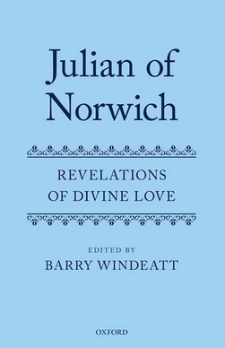 Julian of Norwich: Revelations of Divine Love
Oxford University Press 2015
Translated with an introduction and notes by Barry Windeatt, Professor of English at Cambridge University and Vice-Master of Emmanuel
ISBN 978-0-19-964118-5
Reviewed by: Paul Beasley-Murray
Julian of Norwich (1342-c1416) is the earliest woman whose writing in English can be identified. Little is known about her apart from the fact that she was an ‘anchoress’ in Norwich.
The life of an anchoress was regarded as a living death of one who was as if dead to the world: when an anchoress was shut up in her cell, she was prayed for as if a corpse!
In May 1373, Julian – then aged 30 – thought she was dying. It was at this time she had a series of visions of the crucified Christ.
In some ways her ‘revelations’ were par for the course for medieval Christians, for they were encouraged to enter into the scenes of the Passion and relieve them in their mind’s eye, imaging themselves present in heart and mind, and in doing so often enlarged and elaborated upon the suffering of Christ and the sorrows of those who witnessed it.
Although Julian’s ‘revelations’ are not limited to the Passion, the suffering of Jesus is certainly central to them.
Christian feminists often quote from Julian, because she at times describes Jesus as ‘our mother’.
Julian is also well-known for her assertion that although we cannot know everything here, and we may suffer, nonetheless “all shall be well, and all shall be well, and all manner of things shall be well”.
Julian’s Revelations of Divine Love are to be found in two versions: the ‘short text’ and the ‘long text’. Professor Windeatt has translated both. He has also written a 40 page introduction to Julian. For those wanting to know more about her, this is a very helpful book to turn to.
The Revd Dr Paul Beasley-Murray retired from full-time stipendiary ministry in 2014. His reflections on a 43-year career in ministry are available in a new, four volume guide called Living out the Call.
Baptist Times, 25/09/2015