The Sanity of Belief by Simon Edwards
A good presentation of the intellectual arguments in favour of the truth of the Christian faith - but will postmodern thinkers be persuaded?
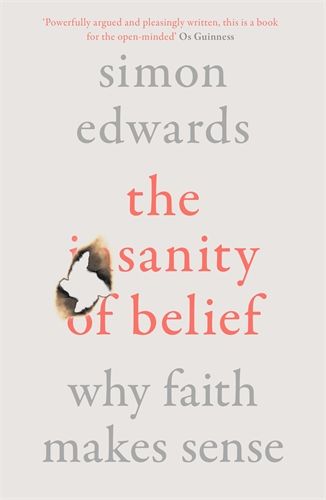 The Sanity of Belief – why faith makes sense
By Simon Edwards
SPCK
ISBN: 978-0-281-08489-0
Reviewed by Philip Clements-Jewery
Simon Edwards, the author of The Sanity of Belief, is a writer and speaker based at the Oxford Centre for Christian Apologetics. It comes with an impressive number of commendations by prominent Christians. The argument of the book is that Christian faith makes sense of reality in all its fullness across the full spectrum of human experience - intellectual, moral, relational, emotional and volitional.
I judge that this is as good a presentation of the intellectual arguments in favour of the truth of the Christian faith as it is possible to make. However, it is plain that this is not simply a work of apologetics; it is more an extended evangelistic tract, calling for the decision of faith. I suggest, though, that it would only be suitable to give to seekers who are educated at least to undergraduate level.
But this is where a few doubts arise in my mind. People educated to university level and beyond might wish to explore further the works cited in the extensive bibliography. However, there are no footnotes that would enable exploration of the quotations and references in the main text.
I also feel that perhaps too much reliance is placed upon the authority of C.S.Lewis. Indeed, one of the people whose commendations are printed at the beginning of the book exclaims that ‘there were moments when I felt like I was reading C.S. Lewis!’ However, Lewis lived and wrote in very different age to our own. Which leads me to suggest that there is also a cultural issue at stake here.
The question is, are people really persuaded by such ways of thinking any more? The kind of arguments found in books like this belong very much within the rationalistic (modern) worldview of the Enlightenment, yet the culture in which we live today is postmodern. Truth has become relative and a matter of personal choice. Yet God, as ever, speaks in the language of a human life. A personal encounter with the risen Christ, mediated through the testimony of believers, may prove more persuasive. In a postmodern era, therefore, the best approach may be to invite people to ‘suck it and see’ and try things out for themselves in the context of a community of other seekers. For many people these days belonging is the way into believing rather than the other way round.
So, in the end I am not sure that I would want to give this book to a postmodern seeker. I would much rather give them Archbishop Stephen Cottrell’s recent book Dear England which has the same intent and purpose as The Sanity of Belief. It might be worth reading both these books alongside each other and noting the difference in style.
Philip Clements-Jewery is a retired Baptist minister living in Huddersfield
Baptist Times, 15/10/2021