Up from the ashes, by 'Dr A' and Samara Levy
An intriguing, deeply moving and occasionally puzzling read, which raises more questions than answers
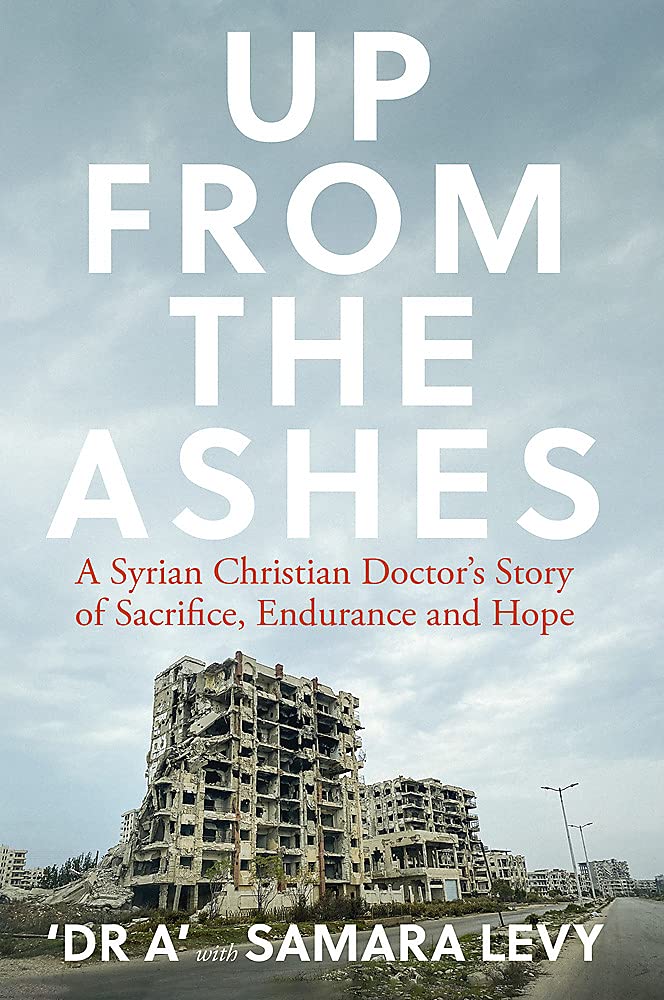 Up from the ashes: a Syrian Christian doctor’s story of sacrifice, endurance and hope
By 'Dr A' and Samara Levy
Hodder and Stoughton
ISBN: 978-1529358421
Reviewed by Terry Young
This two hander – by an emergency care specialist and a charity founder – gets behind the politics and news coverage of the past decade to describe life in Syria under assault from ISIS militants while suffering western embargoes. As I understand it Samara has put the book together based on Dr A’s narratives in English and the result is an intriguing, deeply moving and occasionally puzzling read.
To preserve Dr A’s identity, there is almost no identifiable material in the text – no (real) names of people, no names of cities, and no dates. Parts of the timeline come from the notes and documents cited and it clearly comes up to date with COVID-19. However, three of Kipling’s six honest serving men – who, when and where – are missing in action. This gives the book an episodic, almost dreamlike quality, especially since Dr A ranges back and forth over his lifetime. If you like that sort of narrative – and it would make a compelling film – you will find this a satisfying read. If you don’t, you’ll have to turn up your concentration and forge ahead.
However you read it, the narrative is alive with presences: a loving mother and a father who was often absent through imprisonment or for work, neighbours, loyal boyhood friends and family members, an inspirational professor at Med School, even, not to mention Dr A’s nemesis in the form of another doctor committed to destroying him.
The scenes are vivid, too, often tinged in fear or saturated in blood. God has clearly looked after the poor boy who did well at school and won a scholarship to study medicine, opening his path to national recognition for the emergency systems and services he developed; others have been less fortunate, beheaded, repeatedly raped, or simply lost in the carnage. Although he suffers, he becomes sufficiently wealthy to invest in – and lose – a hospital and his home, but is never without home or resource.
Against this backdrop is a developing story of faith. There is a driven search for meaning, first as Dr A attempts to become the best emergency doctor in the country to solve the problems of the desperately sick and injured. As this prospect evaporates, he seeks to represent the needy in a broader sense, setting up clinics beyond hospital walls, but even here he is thwarted until he finds himself under a sort of voluntary house arrest. Meanwhile, he finds his faith being stripped of its superiority as a Christian whose forebears walked where Jesus walked. He has intense spiritual experiences, and this interplay between inner and outer conflicts draws the reader in. That said, it feels like the book has been written before Dr A has fully resolved these tensions.
So what messages reach the reader? The most obvious is that outside governments have failed to recognise repeated patterns across the Middle East that are clear to an Arab mind, and that their habit of picking partners and intervening has not solved much and may have made matters much worse. If Dr A is right, western media, fixated on imagery for the news, has failed to make even the most elementary distinctions between aggressor and aggrieved.
From his childhood, Dr A remembers Christian and Muslim (Shia and Sunni) coexisting in peace. He acknowledges that Christians struggled to reach the upper echelons of the army, for instance, but contrasts people’s ability to rub along with one another back then against today’s terror unleashed by extremists in which waves of Muslims suffered and from which they also fled. The loss of moderation and the rule of fear is much closer to what one reads of Germany in the ‘30s than to a traditional religious war, as friends retreat from marked men under fear from a spreading gospel of hate that could never deliver the national salvation it promised. The way in which members of the intelligentsia cave in to this gospel is particularly frightening, while the commitment of extremists to breaking the conquered is laid bare as fighters ‘marry’ a captured girl or woman for a few hours before ‘divorcing’ her, so that one of their mates can ‘marry’ her for the next few hours.
At least, this should equip us with a healthy scepticism of what we read and hear from media outlets. It should also make us reflect on what role our own governments may have played in catalysing coexisting communities into tribal terror. It didn’t used to be like this, so what has changed and to what extent were our nations responsible?
Finally, it ought to make us want to find out more in order to pray more effectively for the minority Christian communities, caught up in these disasters – they have the quietest voice of all.
If Dr A is perplexed as to why anyone can view this as a religious struggle, he is also perplexed by a western Christianity he observes from a distance that has drifted so far from its Middle Eastern roots – with divorce, extramarital affairs, and deep-seated materialism. Through Samara, he is introduced to a more vibrant and faithful Christianity in the west, but still, he is puzzled.
As someone who spent a slice of his childhood in the Middle East (and was airlifted out of Beirut during the Six Day War), I was interested in what this would tell me, but I was puzzled, too. I could see glimpses of a hope but finished the narrative without a clear idea of what Dr A’s ‘ark’ might look like.
I suspect that for you, as for me, this will raise more questions than answers, but it is a worthwhile read, all the same.
Professor Terry Young is an author and member of a Baptist church. He set up Datchet Consulting which combines his experience in industry and academia
Baptist Times, 05/11/2021