God’s Book, by Andrew Ollerton
'Though I have concerns on a couple of aspects as a former medical doctor, this is nevertheless a highly readable, helpful primer on some of the Bible’s many tough topics, full of memorable anecdotes and allusions'
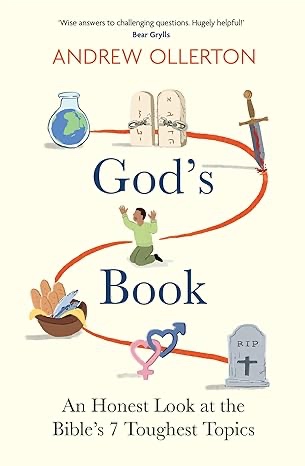 God’s Book - An Honest Look at the Bible's 7 Toughest Topics
By Andrew Ollerton
Hodder and Stoughton
ISBN 9781399806459
Reviewed by Trevor Stammers
This book is exactly what its subtitle states – An honest look at the Bible’s 7 toughest topics and as well as being honest, it's engagingly written and each chapter contains a letter to one of the author’s children on the chapter topic as well as a three or four page side note on related issues such as ‘Are the gospels historically reliable?’ in the chapter on ‘Do miracles and exorcisms really happen?’
The book’s other contents cover creation accounts, OT laws and slavery, warfare, suffering, sex and finally - as is appropriate - the afterlife.
It's highly readable and full of memorable anecdotes and allusions. My favourite is the imagined dialogue between twins in utero – one a sceptic and the other a believer about whether there is life outside the womb or not.
It also gives a good overall sweep of the different views held by Christians on the disputed topics. For example, in the chapter on Genesis, Ollerton outlines the strengths and weaknesses of young earth creationism, old earth gap-theory and old earth day-age theory. On this particular issue he gives his personal view that the latter ‘is more credible as it takes the sequence of days in Genesis 1 seriously while accommodating scientific evidence’ (p24), whereas in other chapters he does not commit to one specific view.
I was particularly interested in finding out the author’s views on judgement and hell in the final chapter as I assumed that being a Keswick speaker he would take the view that hell is a place of eternal conscious torment. To my surprise, though Ollerton is clear on the reality and indeed necessity of hell (“It is God’s way of removing all that would otherwise corrupt the new creation” p 274), when it comes to the nature of hell, he is far less prescriptive. After outlining in an endnote (p332), the traditional view of eternal conscious torment (confusingly abbreviated to ECT - Eternal Conscious Torment} and the annihilationist view (where the person will eventually cease to exist), the author states ‘Christians continue to debate these issues, and the exact nature of ‘hell’ remains a mystery. However, we can trust God will do what is right in the end’. This I felt was a rather unhelpful fudge, rather than seeking to be evenhanded in assessing the mutually contradictory options. On the other hand, as in every chapter, there are recommendations for further in-depth reading on this topic as well as others throughout the book.
There were just two chapters, where I felt the emphasis was rather too enthusiastically placed on evidence adduced to support the authority of scripture. The first of these was the reliance on the accuracy of reports of contemporary miracles to support the accounts of the miracles of Jesus (and others) recorded in the New Testament. The sole source for these accounts is a 2021 book by a US physician which is far too uncritically accepted at face value for a volume that has been challenged.
I am similarly uncomfortable with references to out-of-body (OTB) experiences to support the reality of the afterlife without at least some reference to the fact that the neurophysiology of such experiences is increasingly understood. Although such evidence can never by its very nature disprove true OTB perception it should, I think, caution against putting undue weight on it as evidence for an afterlife.
Such concerns that I have as former medical doctor, do not however outweigh the value of this book as a highly readable, helpful primer for teens and upwards on some of the Bible’s many tough topics, which also has many suggestions for further reading in the extensive footnotes.
Dr Trevor Stammers is a member of the Scottish Council on Human Bioethics and was a GP for 30 years before becoming Associate Professor of Bioethics and Medical Law and Director of the Centre for Bioethics and Emerging Technologies at St Mary’s University, Twickenham
Baptist Times, 27/03/2026