A Church of the People by John Dyer
Important reading for Baptists - John's recipe is end-to-end theological training for all at whatever level is appropriate for each, and the patterns he identifies from Brazil are visible almost everywhere at some level
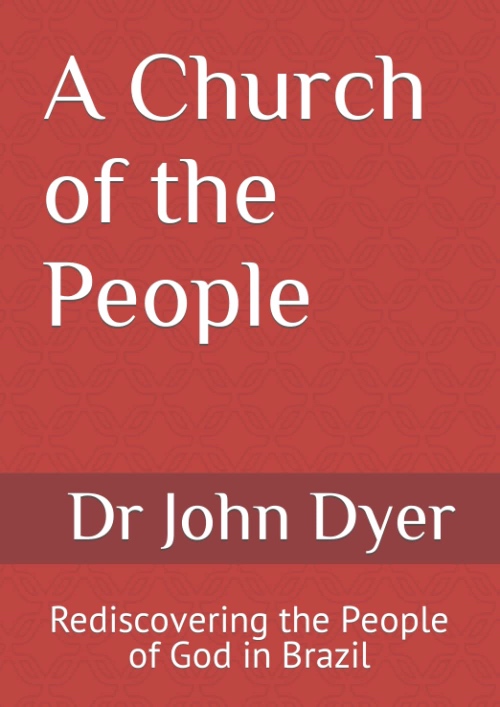 A Church of the People: Rediscovering the People of God in Brazil
By Dr John B Dyer
Independently published
ISBN: 978-1094858739
Reviewed by Terry Young
If you think the quiz question has an answer in South America, it’s usually Brazil, which has almost half the population and land area of the continent and a high growth economy that dwarfs its neighbours. A highly-educated Brazilian friend told me two things that I can’t forget, either: it has the widest genetic mix in the world, and her great grandfather captured her great grandmother with a lasso in the jungle. So, I guess Brazil must be the fastest changing space on earth, too.
This kaleidoscopic backdrop to John’s PhD thesis on theological education in Brazilian Baptist churches makes it both interesting and hard to follow. So, here are three reasons why anyone should read it, before some wider reflections.
First, it’s available as an e-book. Few Christian publishers seem to mandate this, so anyone who publishes electronically deserves all the encouragement you can give them.
Second, it’s cheap (and the Kindle edition is less than half the paperback price). Most Christian books I’ve read are significantly more costly per page than their secular counterparts. John has essentially reprinted his thesis (and theses are horrendously expensive to buy). It’s so cheap that you won’t even need to read all of it to get your money’s worth. I suspect we’ll all spend far more and read far less on newspapers and other media this week.
And you probably won’t read it all: academic writing isn’t really meant for start to finish consumption. They say only three people read a thesis – the author, the external examiner and the internal examiner – and even they don’t read it properly. For most people, Part 3 will be the most relevant and interesting – how to do what he has done – with a bit of backfilling from the earlier in the book.
So, what is the book about? Well, it’s about educating Christians for ministry, but that draws in many other factors. John is into Theological Education by Extension, or TEE (Learning under lockdown: Bible study in a socially distanced world captures the idea). John, a former BMS World Mission worker in Brazil, is especially interested in developing lay leadership in Brazil, where the concept is both new and viewed with suspicion.
John has taken the risk of publishing this independently, but it could really do with a committed publisher and a thoughtful editor to turn it into a trilogy of short books: perhaps one on Baptists in the world today with a nod to Brazil; one on theological education for Baptists; and one on how Baptist church members are expected to grow. Any publishers out there? You might try reading this, too.
Instead of taking people out of their working and church environments to send them off to seminary (where they are surrounded by people who are also at seminary or who have never left), you set up distance learning to interleave their theological development with practical service and, possibly, a full-time job.
So, before John tells you how he persuaded churches, a denominational HQ and a theological college to collaborate in training the laity, he sets off on several crusades. First, he really believes in grass-roots church leadership and is concerned about the professionalisation of ministry represented by seminaries. Thus, there is a slice of theology about the inadequacy of the one-church-one pastor and pastor-dominates-all-other-leadership models of ministry. He even argues that such elevation of the clerisy goes against early Baptist principles.
To fuel these campaigns, John tells us about Baptist history and the development of the denomination around the world. Baptist thinking in Brazil is heavily influenced by South American Roman Catholicism – either in reaction to it, or by seeing how it faces similar cultural challenges – and so he needs to tell us a bit about that, too. I really enjoyed following him around in these recces, and if you like that sort of thing, too, you can dip in and out, too, since the section headings lend themselves to such an approach.
Finally, there are forays into the boggy lands between doctrine and practice. Since the first Christians set out to tell the world about Jesus, three huge structures have grown up: missions, denominational superstructures, and training institutions. Each has the potential to want to control aspects of local churches and also to become a self-sustaining end in itself. All of which explains why this is quite heavy, footnote-laden, reading in places.
Why does this matter? Well, if John is right (and I buy his analysis): you can’t get high growth churches without systematic training for all; you can’t get every member ministry, without decent theology for all; you can’t get holistic social-and-evangelistic outreach without mixed lay and pastoral teams; you can’t release the gifts God has given every church without a development programme that embraces everyone in high-quality extension-type Bible study at one end, and postgraduate-level teaching at the other, whether it be at a seminary or in the community.
This is important reading for any Baptist pastor practising or in training: the patterns John identifies from Brazil are visible almost everywhere at some level. It is interesting reading for any thoughtful Baptist, although you may have to learn a slightly different reading style. Instead of wringing our hands over shrinking churches or praying in anguished sincerity that the search team will find a pastor who ticks every ministry on the impossibly long list it has assembled, why not stop and think? What is stopping us from releasing the gifting God has promised us in promised growth?
John’s recipe is end-to-end theological training for all at whatever level is appropriate for each, and he has shown how to do just that. For £2.99 on your e-reader, what are you waiting for?
Professor Terry Young is an author and member of a Baptist church. He set up Datchet Consulting which combines his experience in industry and academia
Baptist Times, 04/01/2022