Making gaming more accessible for all
Haddon Macdonald, who has lived with cerebral palsy since birth, loves video gaming - but has become increasingly concerned developers are dropping support for accessible controllers
Haddon and David Taylor, his pastor at Thatcham Baptist Church, introduce a campaign co-founded by Haddon to challenge this injustice
David Taylor (DT): When my children were young we used to play computer games together. Now in their 30s, they laugh at the games I currently play on my phone. However I don’t think any of us enjoy gaming as much as my friend Haddon. He absolutely loves video games!
Haddon is also in his 30s and has lived with cerebral palsy since birth. For the last five years I’ve had the privilege to be his pastor, and I’ve seen how he has overcome the challenges of his disability in a number of remarkable ways, from passing his driving test to serving at church on the projection desk.
When it comes to video games though, Haddon faces some tough obstacles. The main one is the size and shape of the handset. Up to now, in designing their handsets video game developers only seem to have had in mind those with a full hand movement. This means that those with cerebral palsy, for example, are at a severe disadvantage.
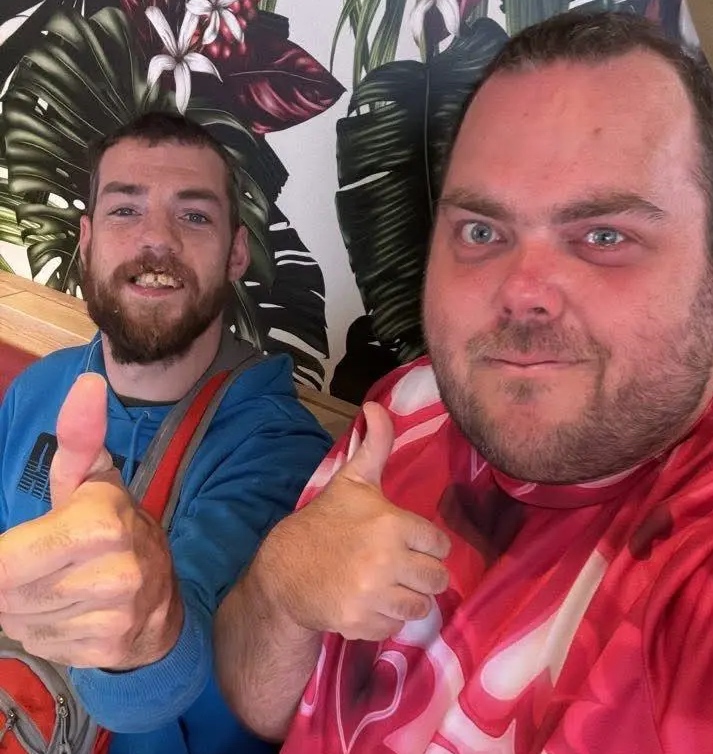 So over the last year Haddon (pictured left) and his friend Simon Ball (pictured right) have started a campaign called Make Gaming More Accessible For All.
They host a Facebook group by this name and have also created the website accessiblegamingforall.co.uk. Now they have launched a petition to Parliament which aims to require gaming developers to make their games adaptable for the disabled user.
The petition can be accessed here and is live until September this year.
In April the campaign even had a response from the Department for Culture, Media and Sport.
Haddon Macdonald (HM): For me, fighting for justice for disabled people is important, as everyone should have the right to do anything they want to do. Gaming should be accessible to everyone who wants to play video games.
As a Christian forgiveness is important to me. Jesus taught us to love one another as he loved us. So I wanted to forgive the games developers for their mistakes by acting in love and peace. I know this leads to better relationships with both individual people and companies.
However it's no good to say that only people who are fit are allowed to play video games. Disabled people should have this right too.
DT: Before I got to know Haddon, I had never thought about the difficulties of playing video games for those without a full hand movement. Haddon’s persistence and perseverance in raising this issue has both challenged and inspired me. I was glad to be able to introduce him to the Baptist Union Disability Justice group and I know their support has been a big encouragement to Haddon.
The national Disability Justice Hub
The national Disability Justice Hub was approached by Haddon and David to reflect with them. Whilst the group didn’t have any direct experience they were able to provide ideas and resources.
Representing the Specialist Teams on the group Mike Lowe said ‘The Disability Justice Hub was very pleased to welcome Haddon and David to one of our meetings, listen and learn together. We wish Haddon well with his petition and hope it leads to further conversations and a positive way forward’.
Mike goes onto say ’The Hub is a reflecting space for disability issues, theology and local church practice and welcomes conversations and additions to our disability blogs Talking about Disability, Church and Faith.’
The group can be contacted here and Talking about Disability, Church and Faith can be accessed here.
02/06/2026