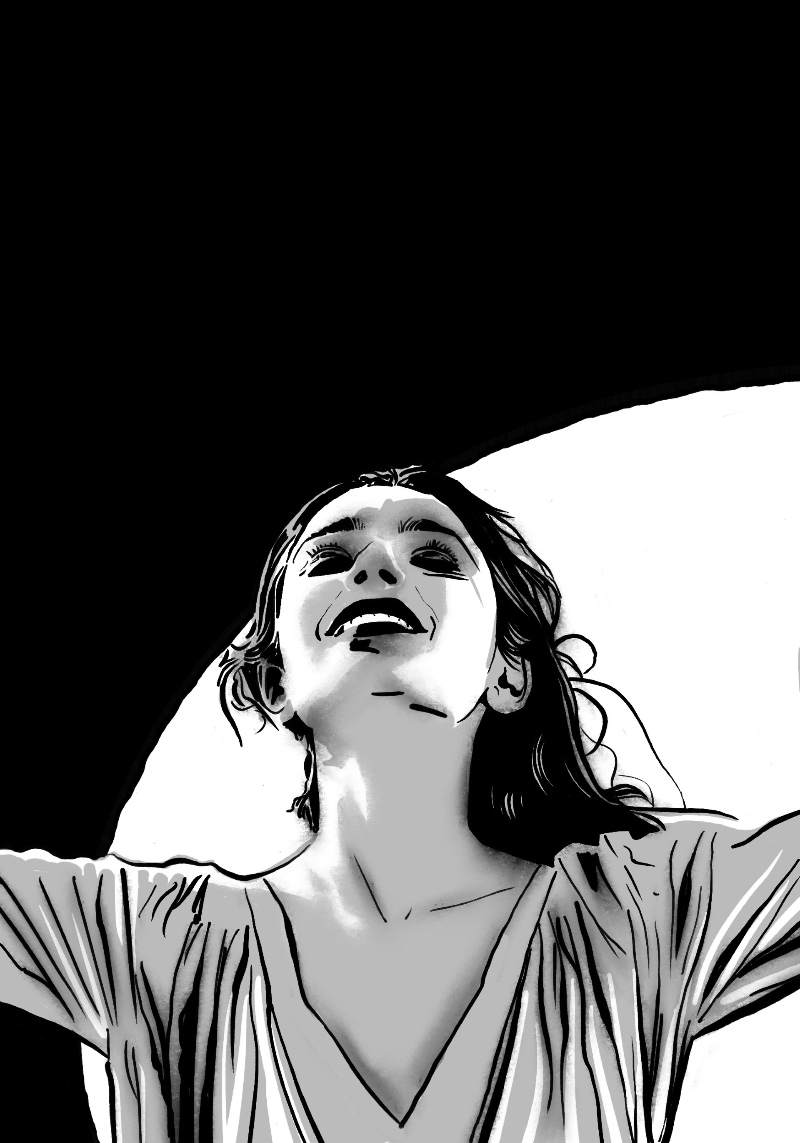
‘Keep looking up, don’t look down’
An extract from Fringe Dweller by Jonny Baker and David Cotterill, a collection of 40 reflections based on encounters in the gospels of Jesus. This one focuses on the woman who crippled by an evil spirit in Luke 13:10-17.
The book 'is an invitation to encounter the person of Jesus Christ afresh through scriptures and in prayer as your own story, life and call dialogues with Jesus' life,' say the authors.
Each reflection includes a practice and a liturgy
Read a review here
 Flip The Script: Luke 13:10-17
One Sabbath day as Jesus was teaching in a synagogue, he saw a woman who had been crippled by an evil spirit. She had been bent double for eighteen years and was unable to stand up straight. When Jesus saw her, he called her over and said, “Dear woman, you are healed of your sickness!”
Then he touched her, and instantly she could stand straight. How she praised God!
But the leader in charge of the synagogue was indignant that Jesus had healed her on the Sabbath day. “There are six days of the week for working,” he said to the crowd. “Come on those days to be healed, not on the Sabbath.”
But the Lord replied, “You hypocrites! Each of you works on the Sabbath day! Don’t you untie your ox or your donkey from its stall on the Sabbath and lead it out for water? This dear woman, a daughter of Abraham, has been held in bondage by Satan for eighteen years. Isn’t it right that she be released, even on the Sabbath?” This shamed his enemies, but all the people rejoiced at the wonderful things he did.
Reflection
This encounter takes place in the synagogue where Jesus was teaching. I imagine him in a small village synagogue sat on the floor with a group around him hanging on his every word. It’s the sabbath, a busy day with people coming and going. A woman comes in who is bent double. She has been like this for eighteen years. She looks at the ground and can’t physically look up. She is like a tree on a coastal cliff top that has been blown so much that it now is permanently bent over in the direction of the wind. Only in her case the wind that has blown is described as an evil spirit.
When people are bent over, they can’t look up easily. Perhaps they can manage a sideways look but that’s about all. People are bent over for many reasons - physical, spiritual, or through the body’s response to trauma or perhaps most likely some combination. Recent discoveries have shown how ‘the body keeps the score’. A body that is bent over suggests something internal that is also bent over and isn’t able to look up.
In this case it is both spiritual and long term; she has been bent over for eighteen years. The one in the bible who opposes God, known as Satan, is described as the Accuser and the Father of Lies. It is reasonable to assume that an evil spirit follows this same line and is a whisperer of lies, of false accusations, and generates destructive inner scripts. When those lies are internalised they become very toxic to body and soul. It is common to have that sort of internal script saying ‘who do you think you are?’, ‘you’re not good enough’ or ‘stupid idiot’ and so on. I should add that I am not suggesting someone with a negative voice in their head is possessed by an evil spirit. I am simply choosing to stay with the language of the account.
When someone is bent over they look down. When someone is bent over, very often they also look down on themselves. Over time it’s possible to lose yourself or at least your sense of self and worth this way. Self-pity, self-hatred can follow that seem to deepen a downward spiral. When that is the case it can be hard for people to remember how to find their way back to who they are.
When Jesus looks up and sees the woman bent over he calls her to him. Unlike some other instances he doesn’t ask if she wants to be healed, doesn’t require faith or anything else on her part. I find this reassuring, that when we are in a place of being bent over in our spirit through lies and shame and have lost the strength or memory to seek a way out, Jesus doesn’t make demands. He sees us and calls.
She makes her way across the synagogue to him. He then heals her through reaching out to touch her and she is freed. She stands tall. I imagine it was dramatic for a body bent over for eighteen years to straighten up; there must have been creaking and clicking of bones, a recalibration of muscles and tissue. No doubt there was a change in her face too, a look of amazement, relief, freedom, of being loved. Those eyes that have just been looking down at the ground dart from side to side daring to look around, to look up, and settle on looking at Jesus. Spontaneous joy and clapping erupt from those listening to Jesus’ teaching. What a moment.
What did Jesus say to the woman at that moment? When I picture the scene I imagine that he encourages her to pay attention to the practice of standing tall, and to not listen to the words and inner scripts that would have her bend down again. ‘Keep looking up, don’t look down’. Repentance for those who experience shame may be learning to stand tall, to straighten up, to look up. It is also resisting the temptation to curl up in a ball or look down. Old patterns and habits die hard. It can be easy to slide back into them. In some ways there can be an odd comfort in being down on ourselves rather than taking the risk of believing we are loved, and that we are enough. It’s an inverted pride, what I sometime think of as worm pride focused on self but in a ‘poor me’ sort of way.
For many who experience this sort of inner struggle it’s actually not a one-off healing that is required. It is ongoing, a courage, a determination to believe a different story, a different word about who they are, to keep learning to flip the script. What better word can there possibly be than one from the One Who Straightens Backs?!
My instinct when I read the story is that I don’t want to look at the synagogue leader’s response. I find it too painful and too familiar. He can’t seem to see what has just happened in front of his own eyes. He is indignant that people are coming for healing on the sabbath. He is concerned with what he perceives to be the right thing to do under the rubrics of the law. It’s so petty, so pathetic.
When Jesus rips into the Pharisees and religious teachers of the law in Matthew 23 I imagine all of these experiences of his are what he is responding to and perhaps he has this woman in mind when he says ‘They crush people with their religious demands and never lift a finger to ease the burden’ (Matt 23:4). Religion gone awry puts burdens of guilt, shame and judgement on people who feel they can’t live up to expectations and that they are not good enough.
And lest we think that was the Pharisees back then, religious burdens still cause many people to look down and be bent double. Those burdens are in many traditions whether protestant, Catholic, liberal, evangelical, pentecostal. This is so counter to the freedom and liberation found in Jesus.
Response
Practice: Body prayer
Put on a track of music, something open and expansive and instrumental.
Bend over double and then slowly straighten up, stand tall and turn your face up and rest in God’s presence. Perhaps hear the words ‘stand tall’ or whatever else you sense the Spirit might be saying to you at this time. Then simply rest in that posture for a while.
Practice: Reverse poetry
We all have scripts, stories we tell ourselves that we have internalised. They can be things we mutter out loud to ourselves ‘you’re so stupid’ or something in our own heads. It can be an ongoing challenge to flip those scripts when they have become so much part of our internal dialogue. Pause and reflect on what scripts you might have about yourself. Take one and ponder what it might look like to play with it, to flip it.
A reverse poem says one thing when you read it top to bottom and another if you read from bottom to top. Compose a reverse poem using your script. It works to have every other lines alternating negative and positive statements and something more neutral in-between. It’s not an exact science - have a play. And it doesn’t have to be long. Three lines is a good start. Here is an example:
Take Up Space
No one likes you
Don’t believe that
When you walk into a room
People are pleased to see you
You’re boring and have nothing to say
So don’t think that
You’re surrounded by love
People don’t want to talk to you
And it’s a mistake to think
You have a place here
Retreat to the edges and keep quiet
They don’t want you to
Take up space[1]
Liturgy: A blessing for one bent over
May you know what it is to be loved
deep at your core
your essence,
your soul,
your self.
May you lose all fear and shame
in the presence of the One whose love knows no ending,
no conditions,
and is not subject to performance
or winning approval.
May all the lies and accusations
that cause you to look down
and be down on yourself
lose their shaping power.
May poisonous words that have become your inner scripts be flipped
as you hear and receive a new word from the Word.
May your wounding ease
in the presence of the One Who Straightens Backs.
In His love may you unfurl
and risk bringing the most hidden and vulnerable parts of you into the light
and find welcome at the table where there is only love,
and fear has no place.
May you resist the temptation to go back,
to bend again,
to look down,
to be down on yourself,
And may you grow in a quiet inner confidence and strength
in the gift of who you are
the gift God made
You
are
loved.
Stand tall!
Amen
[1] Written by Jen Baker and used with permission
Illustration | Jon Birch
 Fringe Dweller, by Jonny Baker and David Cotterill is published by and available at GETsidetracked.
This extract is republished with permission
Read a review here
Do you have a view? Share your thoughts via our contact form
Baptist Times, 03/04/2026